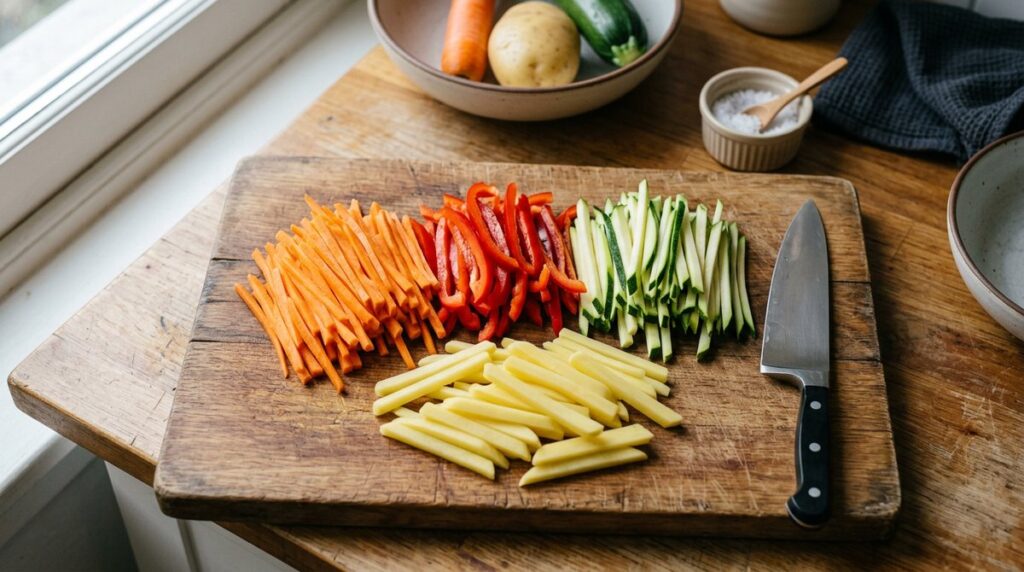
Julienne is a classic knife technique that turns vegetables into slender, uniform matchsticks. Cutting your vegetables to the same size ensures they cook evenly and finish at the exact same time. This simple guide will help you master the cut using just a chef’s knife and a cutting board.
Why This Works
- Uniform thickness means every piece exposes the same surface area to heat, so they cook through evenly—no more half-burnt, half-raw bits.
- Matchstick shapes create more edges that crisp up beautifully when roasted, fried, or air-fried, giving snacks a satisfying crunch.
- Consistent sizing helps you predict cooking times accurately; once you know how long a 1/8-inch [3 mm] carrot strip takes to brown, you can rely on it.
- Small, even pieces are easier to toss with seasonings, ensuring every bite gets the same flavor.
- A neat julienne turns a pile of vegetables into an appealing garnish or a snack that looks as good as it tastes.
What You Need
- 8- to 10-inch chef’s knife, freshly sharpened
- Large, stable cutting board
- Damp kitchen towel or paper towel (to anchor the board)
- Vegetable peeler (optional, for carrots or potatoes)
- Ruler (helpful when you’re learning, not required)
Ingredients
- 1 large carrot, scrubbed or peeled
- 1 medium zucchini, ends trimmed
- 1 large russet potato, scrubbed
- 1 red bell pepper, stemmed and seeded
Instructions
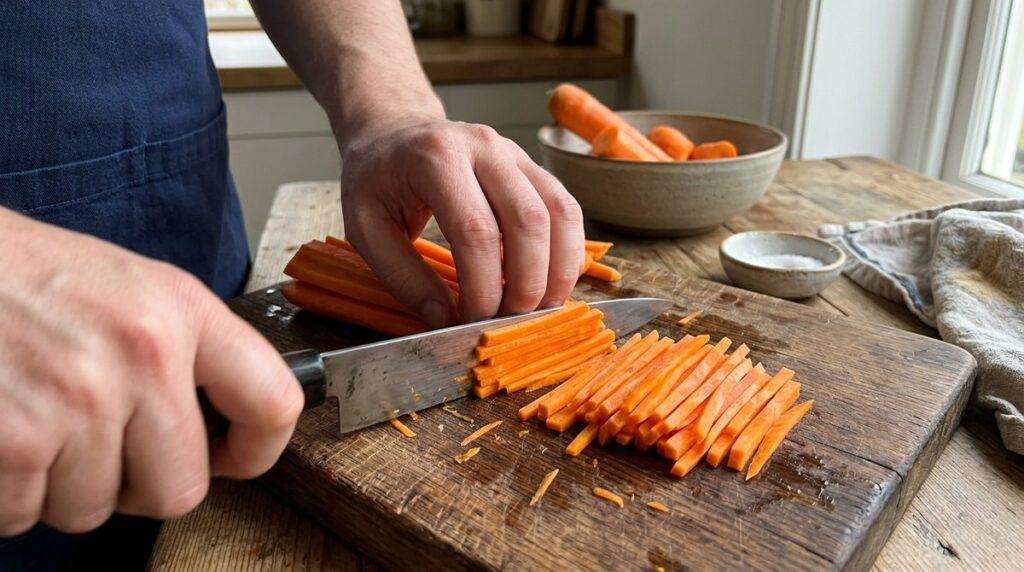
- Stabilize your cutting board. Place a damp kitchen towel or a sheet of damp paper towel flat under your cutting board. Press the board down firmly—it should not slide at all. A stable surface is the first rule of safe, accurate cutting.
- Prep the vegetable. Wash and dry your vegetable. Peel it if the skin is tough or you prefer it removed (carrots and potatoes are often peeled; zucchini and bell peppers typically are not). Trim off both ends so you have a flat, even starting point.
- Create a flat base. For round or irregular vegetables, cut a thin slice lengthwise off one side to create a flat surface. Lay that flat side down on the board. The vegetable should now sit securely without rolling. This step is essential for control and uniformity.
- Cut into planks of even thickness. With the vegetable stable, slice it lengthwise into slabs that are about 1/8 inch [3 mm] thick. Keep your fingers tucked into a claw grip—fingertips curled under, knuckles guiding the blade. Aim for the same thickness on every plank; using a ruler for the first few cuts can train your eye.
- Stack and square the planks. Stack 2 or 3 planks on top of each other, aligning the edges. If the ends are uneven, trim them square with a single crosswise cut so you have a neat rectangular stack. This makes the final matchsticks uniform in length.
- Slice into matchsticks. Holding the stack steady with your claw grip, cut lengthwise through the planks at 1/8-inch [3 mm] intervals. Work from one side to the other with a smooth, controlled motion. The result should be slender batons roughly 1/8 x 1/8 inch [3 x 3 mm] thick and 2 to 3 inches [5 to 7.5 cm] long.
- Check and separate. Gently separate the pieces with your fingers and spread them out. Look for any that are noticeably thicker or thinner. Set those aside for a different use or give them a quick trim. Consistent size matters more than absolute precision.
- Practice on different shapes. For a bell pepper, cut it into flat panels first by slicing off the top and bottom, then cutting down one side and opening it flat. Remove the white ribs, then proceed with planks and matchsticks. For a zucchini, the method is the same as a carrot but requires a lighter touch because it’s softer.
Tips for the Best Results
- Always use a sharp knife. A dull blade requires more force, crushes the vegetable’s cells, and is more likely to slip.
- Keep your guiding hand in a claw grip at all times—fingertips curled under, knuckles against the side of the blade. This protects your fingertips and gives you better control.
- If the vegetable is very long, cut it in half crosswise first so the pieces are easier to handle. Aim for final matchsticks around 2 to 3 inches [5 to 7.5 cm] long.
- For slippery vegetables like zucchini, pat them completely dry before cutting. A tiny bit of moisture can make them slide.
- When learning, use a ruler to check your plank thickness. After a few sessions, your eye will naturally judge 1/8 inch [3 mm].
- Work at a steady, unhurried pace. Speed comes with muscle memory; focus on evenness first.
Troubleshooting
Planks are wedge-shaped instead of flat
Your knife blade is tilting. Keep the blade perpendicular to the board. Check your grip: the knife should be an extension of your forearm, not angled inward or outward.
Vegetable rolls or wobbles during cutting
You skipped the flat base. Always cut a thin slice off one side of a round vegetable so it sits firmly. If it still moves, your board may be unstable—re-dampen the towel underneath.
Matchsticks come out different lengths
Square off the ends of your stacked planks with a single crosswise cut before slicing into strips. That way, all pieces start from the same length.
Knife sticks to the vegetable or crushes it
The knife is too dull, or you’re pressing down instead of using a smooth forward slicing motion. Sharpen the knife and draw the blade toward you slightly as you cut.
Storing and Re-Crisping
Place julienned vegetables in a bowl of cold water, cover, and refrigerate for up to 24 hours. This keeps them crisp and prevents browning. Drain well and pat completely dry with a clean kitchen towel before cooking—excess water will cause steaming instead of browning. For potatoes, change the water once if it becomes cloudy. Do not store cut vegetables at room temperature for more than 2 hours, and ensure any cooked leftovers are cooled and refrigerated within 2 hours.
Variations to Try
- Fine julienne: Cut planks and matchsticks 1/16 inch [1.5 mm] thick for delicate garnishes or quick-pickled vegetable toppings.
- Batonnet: A thicker cut at 1/4 inch [6 mm] square, great for sturdy oven fries or vegetable skewers that need a longer cook time.
- Julienne for slaws: Use the same technique on cabbage or Brussels sprouts by first halving and coring them, then slicing the flat faces into thin shreds.
- Wavy matchsticks: Use a crinkle cutter (a hand-held slicing tool with a wavy blade) on the planks before cutting into strips for extra texture in salads.
- Mixed vegetable chips: Julienne a combination of root vegetables—sweet potatoes, parsnips, beets—and bake or fry them together for a colorful snack mix. If deep-frying, heat your oil to between 325°F and 375°F [163°C to 190°C], and never let it exceed 400°F [204°C]. Never leave hot oil unattended, and always keep a metal lid nearby to smother any flames.
Frequently Asked Questions
What’s the difference between julienne and matchstick cuts?
They are essentially the same. In classic knife work, julienne refers to strips about 1/8 inch [3 mm] thick and 2 to 3 inches [5 to 7.5 cm] long. Matchstick is the casual term home cooks often use for the same size.
Can I julienne soft vegetables like tomatoes?
It’s very difficult to julienne a ripe tomato because the flesh is too soft and full of liquid. For a similar effect, use firm Roma tomatoes, seed them, and cut the flesh into strips. For most snacks, stick to firm vegetables like carrots, potatoes, jicama, or bell peppers.
Do I need a special knife for this?
No. A standard 8- to 10-inch chef’s knife works perfectly. The key is that it’s sharp and comfortable in your hand. Avoid small paring knives for large vegetables—they make it harder to keep cuts even.
How do I avoid cutting myself?
Always use the claw grip: curl your fingertips under and let your knuckles rest against the side of the blade. That way, the knife can’t reach your fingertips. Go slowly, and never cut toward your body. A stable board is also essential.
Why do my matchsticks turn brown before I cook them?
Some vegetables, like potatoes and artichokes, oxidize when cut and exposed to air. Submerge them in cold water immediately after cutting and keep them in the fridge until you’re ready to cook. Drain and dry them thoroughly right before using.
Can I use a mandoline instead of a knife?
Yes, a mandoline can produce very even julienne quickly, but it requires careful handling. Always use the hand guard and never run your bare hand near the blade. Even with a mandoline, you still need to square off the vegetable first for uniform length.