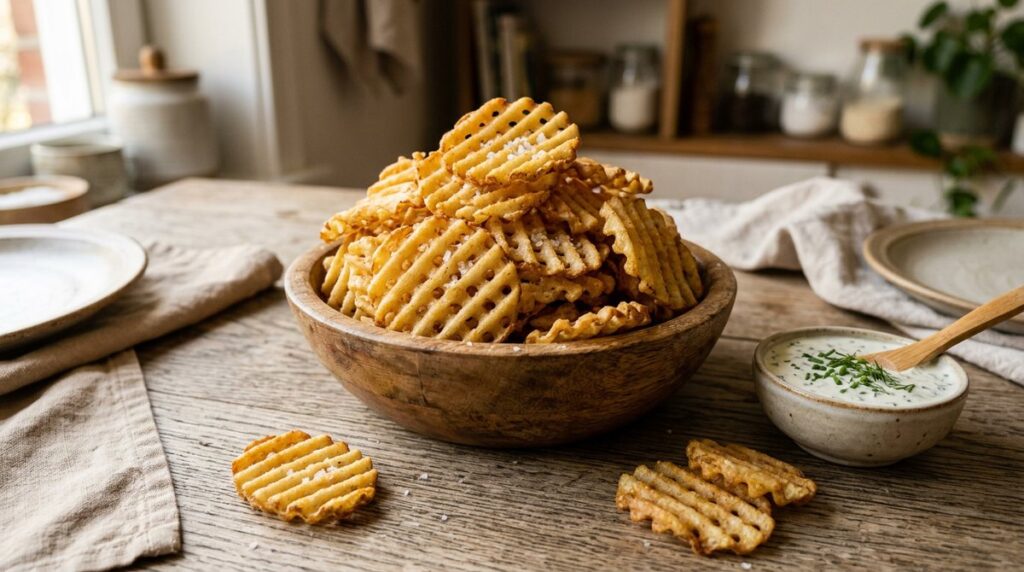
Making waffle-cut potato chips at home is simple when you know the right technique.
By rotating a crinkle cutter 90 degrees between each slice, you can easily create the classic open-lattice pattern.
This guide covers the cutting method, starch-removal soak, and safe frying steps for perfectly crispy chips.
Why This Works
- Rotating the potato 90 degrees between each crinkle cut allows the perpendicular ridges to intersect, creating the open lattice holes.
- Soaking the cut chips in cold water pulls out excess starch, which prevents sticking and encourages an airy, crisp texture.
- Thorough drying after soaking is essential because any water left on the chips will make the oil splatter and steam the potatoes.
- Frying at a steady 350°F (175°C) cooks the thin slices quickly all the way through so they stay crunchy.
- Immediate seasoning while the chips are hot from the oil helps the salt and dry spices cling evenly to the ridges.
What You Need
- crinkle cutter (handheld or a mandoline with a crinkle blade)
- cutting board
- large heavy-bottomed pot (4 to 6 quarts [3.8 to 5.7 liters])
- instant-read thermometer
- spider strainer or slotted spoon
- rimmed baking sheet
- paper towels
- cooling rack (optional)
Ingredients
- 2 large (about 1 1/2 lb / 680 g) russet potatoes, scrubbed
- about 8 cups (2 liters) vegetable or peanut oil, for frying
- to taste fine sea salt
Instructions
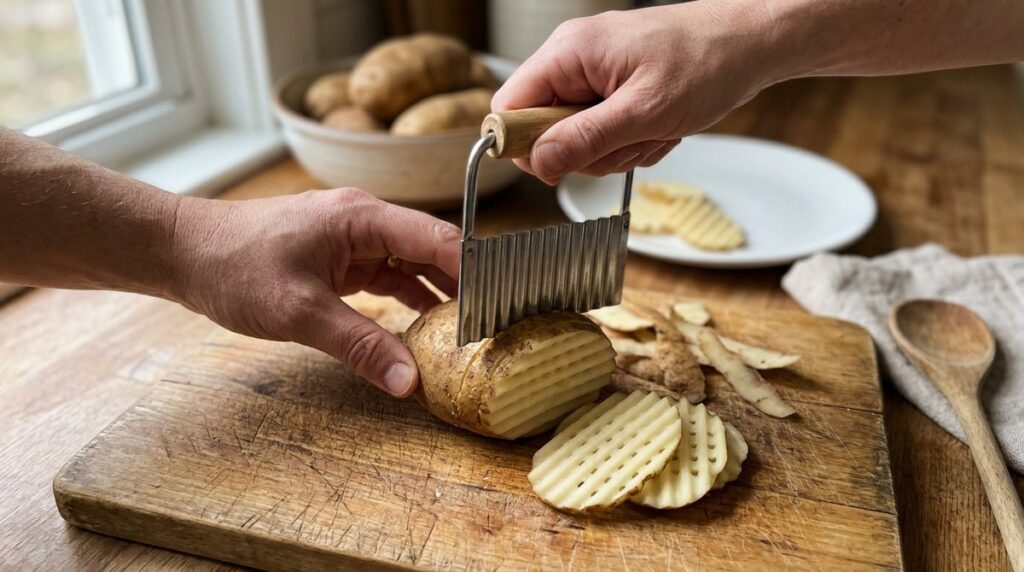
- Set up your work area. Scrub the potatoes clean. You can leave the skins on for a rustic look or peel them if you prefer. Pat them completely dry. Place a damp kitchen towel under your cutting board to keep it steady.
- Make the first cut. Cut off one end of the potato using the crinkle cutter. This first slice will be wavy on one side and flat on the other; discard it or save it for another use. You now have a corrugated face on the potato.
- Rotate and slice. Rotate the potato 90 degrees. Position the crinkle cutter about 1/8 inch (3 mm) behind the corrugated face and slice straight down. The perpendicular waves will intersect, creating the classic waffle pattern with small holes.
- Repeat the rotation. Rotate the potato 90 degrees again before making the next slice. Continue rotating the potato 90 degrees between every single slice to maintain the lattice pattern. Keep the slice thickness consistent at about 1/8 inch (3 mm).
- Soak the slices. Drop the waffle slices into a large bowl of cold water. Let them soak for at least 30 minutes, or up to 2 hours. This step removes excess surface starch, which is essential for achieving a crisp texture.
- Drain and dry thoroughly. Drain the potato slices in a colander, then spread them in a single layer on clean kitchen towels or paper towels. Pat each chip completely dry. Any remaining moisture will cause the hot oil to splatter violently.
- Heat the oil safely. Pour the oil into a large heavy-bottomed pot until it is 2 to 3 inches (5 to 7.5 cm) deep. Clip an instant-read thermometer to the side. Heat the oil over medium-high to 350°F (175°C). Never leave hot oil unattended, and keep a metal lid nearby to quickly smother any flare-ups.
- Fry in small batches. Carefully lower a small batch of dried potato slices into the 350°F (175°C) oil using a spider strainer. Do not crowd the pot; fry in 4 to 5 batches. Cook for 2 to 3 minutes, flipping them halfway through. Remove them when they are pale golden and the bubbling slows.
- Drain, season, and cool. Transfer the hot chips to a paper towel-lined baking sheet. Sprinkle with fine sea salt immediately so it sticks. Let the chips cool completely on the sheet; they will continue to crisp up as they cool. Cool any leftovers within 2 hours before storing.
Tips for the Best Results
- Use a sturdy crinkle cutter with sharp blades—dull ones tear the potato instead of making clean cuts, which ruins the lattice pattern.
- Soak the slices for at least 30 minutes; for extra-crisp chips, push it to 2 hours and change the water once if it turns cloudy.
- Dry each chip with attention. Lay them between paper towels and press gently. Any lingering water will cause dangerous splattering and soggy chips.
- Fry in very small batches. A single layer that doesn’t overlap is the rule; too many chips drop the oil temperature below 325°F (163°C) and make them greasy.
- Keep an eye on the thermometer and adjust the burner to hold the oil steadily between 325°F (163°C) and 375°F (190°C), aiming for 350°F (175°C).
- Line a baking sheet with fresh paper towels for each batch. Used towels hold moisture and can soften the chips you already fried.
Troubleshooting
Chips came out soggy
The oil temperature likely fell below 325°F (163°C), or the chips were not dried well after soaking. Check your thermometer and make sure each slice is bone-dry before frying. Fry in smaller batches.
Chips burned before cooking through
The oil was too hot (above 375°F / 190°C). Lower the heat and let the oil cool back to 350°F (175°C). Thin potato slices cook quickly; a steady moderate temperature browns them evenly.
The waffle pattern has no holes
The slices were cut too thick. If the slice is thicker than 1/8 inch (3 mm), the perpendicular ridges will not intersect deeply enough to form the open lattice holes. Slice them slightly thinner.
Chips curled and folded on themselves
Some curling is normal. Press gently with the spider strainer as soon as the slices hit the oil to keep them flat. Consistent slice thickness also helps reduce exaggerated curling.
Storing and Re-Crisping
Cool the chips completely. Store them in an airtight container at room temperature for up to 3 days. Ensure leftovers are cooled and packaged within 2 hours of cooking. To bring back the crunch, spread them on a baking sheet and warm in a 300°F (149°C) oven for 3 to 5 minutes.
Variations to Try
- Salt and vinegar chips: After frying, spritz the hot chips lightly with cider vinegar, then sprinkle with salt. The vinegar cooks off slightly from the heat, leaving a tangy bite.
- Barbecue seasoning: Toss finished chips with a mix of smoked paprika, brown sugar, garlic powder, and a pinch of cayenne while they’re still hot.
- Garlic-herb: Combine dried rosemary, thyme, garlic powder, and finely grated hard cheese (like Parmesan) and toss with the hot chips directly out of the oil.
- Sweet potato waffle chips: Substitute sweet potatoes, but lower frying temperature to 325°F (163°C) and watch carefully—they brown faster. Soak and dry the same way.
- Air-fryer method: After soaking and drying, spray the slices lightly with oil, arrange in a single layer in the air-fryer basket, and cook at 375°F (190°C) for 10 to 12 minutes, shaking halfway.
Frequently Asked Questions
Can I make waffle-cut chips without a crinkle cutter?
No, you need a crinkle cutter or a mandoline with a crinkle blade. A standard straight knife cannot create the alternating ridges required to form the open lattice pattern.
Why do I need to soak the potato slices?
Soaking removes surface starch that would otherwise make the chips stick together and turn chewy. The water also helps the slices crisp up instead of burning on the outside before cooking through.
What oil is best for frying these chips?
Choose a neutral-flavored oil with a high smoke point. Vegetable, canola, and peanut oil all work well. Avoid extra-virgin olive oil; it can burn and add a bitter taste.
How can I keep the chips from getting greasy?
Maintain the oil at a steady 350°F (175°C), fry in very small batches, and drain on fresh paper towels. Drying the slices completely after soaking also stops them from absorbing excess oil.
Can I reuse the frying oil?
Yes. Let the oil cool completely, strain it through a fine-mesh sieve lined with cheesecloth, and store it in a sealed container in a cool, dark place. You can reuse it 2 to 3 times. Discard if it smells off or smokes before reaching 350°F (175°C).
My chips are crisp at first but turn soft after sitting out—what went wrong?
The chips likely were not dried enough before frying, or they cooled in a humid spot. Always dry slices completely and store chips in an airtight container within 2 hours of cooking.